Tag: Spring Balancer

  • Weather-Proofing Old Wood Windows with Clock Spring Balancers

    Weather-Proofing Old Wood Windows with Clock Spring Balancers

    Old houses have undeniable soul. They have character, history, and craftsmanship that modern builds just can’t replicate. They also have winter drafts that can blow out a birthday candle from three rooms away.

    If you own a historic home, you know the struggle: you want to keep your original wood windows, but your heating bill is screaming for mercy. Traditionally, those beautiful old windows rely on a system of heavy cast-iron weights, cords, or chains hiding inside hollow pockets in your walls.

    But what if you could eliminate those drafts, pack those hollow pockets with high-efficiency insulation, and keep your historic windows operating flawlessly? Enter the clockwound spring balance.

    🛑 A Quick Reality Check for SEO Wanderers

    Before we dive in, let’s get one thing straight: This article is strictly for true historic wood windows. If you have vinyl windows, aluminum frames, or pretty much any window manufactured in the last 50 years, this solution will not work for you. Clock spring balances are a specialized, century-old technology engineered specifically for the weight and structure of traditional wood sashes.
    The Hidden Culprit: The Window Weight Pocket

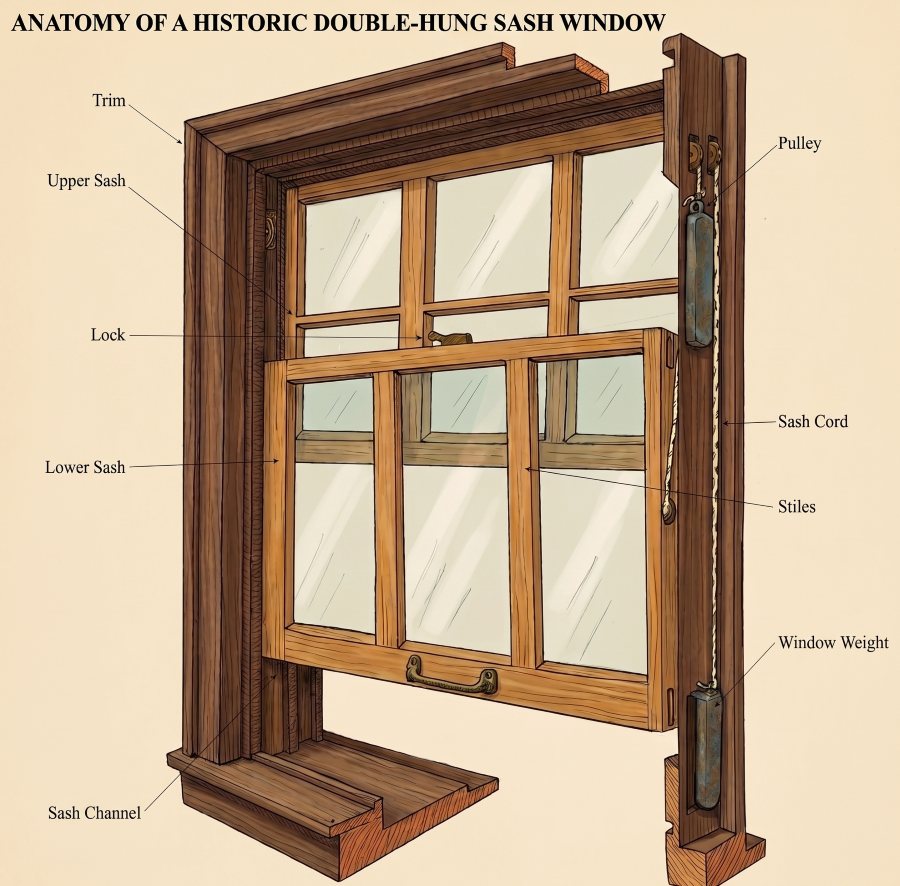
    In a classic double-hung wood window, the sashes are counterbalanced by iron weights hidden inside the wall framing. To let those weights move up and down, the window cavity has to remain entirely hollow.

    Unfortunately, a hollow wall cavity right next to a window is a thermal nightmare. It acts as a superhighway for freezing winter air, radiating cold into your living room and letting your expensive heated air escape. You can caulk and weatherstrip the sash all day long, but cold air will still pour through the weight pocket itself.
    The Solution: Clockwound Spring Balances

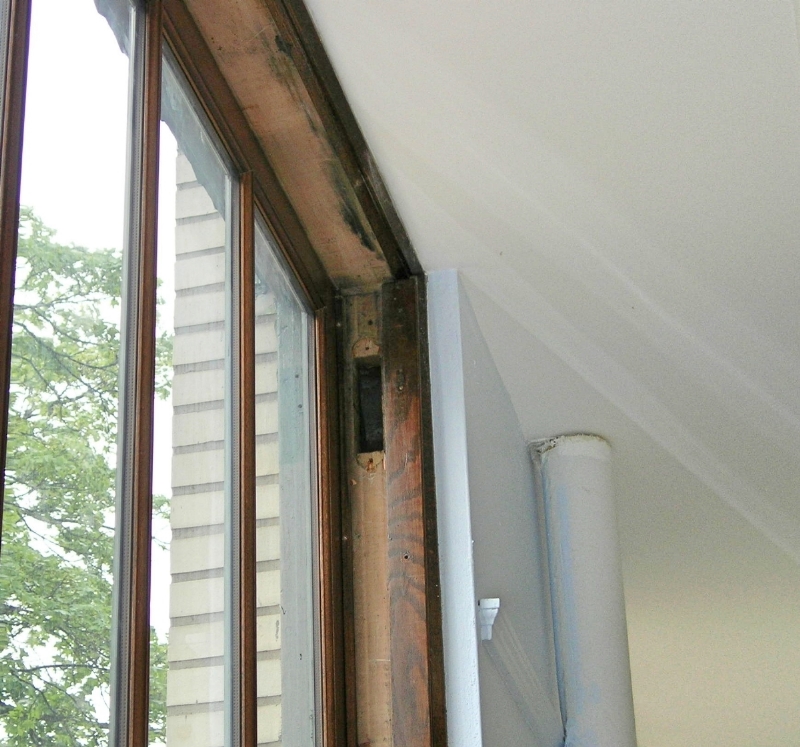
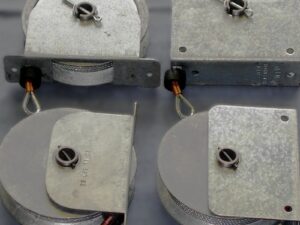
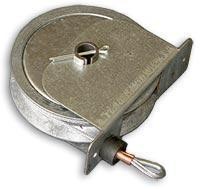
    For over a century, clever builders and restorers have used clock spring balances as a mechanical upgrade. Instead of a bulky weight swinging on a rope, a compact, spring-loaded mechanism is mounted directly into the window jamb.

    As you open the window, a flat steel tape extends, and a tightly wound internal clock spring creates the perfect tension to hold the sash in place. Trusted historic brands like Pullman Mfg, Caldwell, and Acme perfected this technology decades ago, and their designs remain the gold standard for historic restoration today.

    By swapping out the old weights and pulleys for clock spring balances, you completely free up the space inside the window frame.

    The Big Benefits: Warmth, Comfort, and Savings with spring counterbalances

    Once those clunky weights are gone, the real magic happens. You can now fill that notoriously drafty wall cavity with spray-in foam insulation.

    Here is why this upgrade is a game-changer for historic homeowners:

    • Slashed Heating Bills: Sealing and insulating the weight pockets eliminates one of the largest sources of heat loss in an old home. Your furnace won’t have to work overtime to fight off the creeping chill.
    • Next-Level Comfort: Say goodbye to localized cold zones. Insulating the perimeter of your historic windows stops the radiant cold draft, making the seating areas near your windows actually usable in January.
    • Preserved Historic Integrity: You get to keep your original exterior trim, historic glass, and beautiful wood sashes. From the outside, no one will know anything has changed—but your thermostat will.

    Bulletproof Dependability

    When people hear the word “spring,” they often worry about cheap, modern hardware store springs that stretch out and snap after a few years. Clockwound balances are an entirely different beast.

    These units are built with heavy-duty, industrial-grade steel. Brands like Pullman and Caldwell didn’t design these for temporary fixes; they designed them to last for generations. Because the tension is evenly distributed across a coiled clock spring, they maintain their lifting power for decades with virtually zero maintenance. They don’t rot like cotton sash cords, and they don’t rust out like old chains.

    Is This Right For Your Restoration Project?

    If you are tackling a historic wood window restoration and want to drastically improve your home’s energy efficiency without sacrificing its architectural DNA, clock spring balances are the ultimate hidden upgrade. You get the smooth, effortless operation of a perfectly balanced window, combined with the modern comfort of a fully insulated wall.
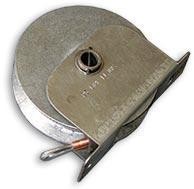
  • Spring Balancers for Industrial Applications

    Spring Balancers for Industrial Applications

    Cable Counterbalance Spring Balancer Intro:

    Common names for industrial counterbalances: Tool balancers, tool retractors, cable counterbalances, tensioners, spring balancers, and cable pulleys.

    Industrial SPRING counterbalances play a crucial role in various applications by providing a counteracting force to maintain balance and improve efficiency. This white paper explores this specific technology, its function, and key points for selecting the right counterbalance for your specific needs. The advantages of using spring counterbalances and real-world examples of their applications are noted. 

    What are Industrial Counterbalances?

    An industrial counterbalance is a weight or spring-loaded mechanism that creates an opposing force to offset the weight of another object. This helps to achieve equilibrium within a system, preventing unwanted movement or strain. 

    Applications for Spring Balancers:

    Counterbalances are used extensively in various industrial settings, including:

    • Tool Balancers: These utilize load capacity and spring tension to suspend tools in a designated location, improving ergonomics and reducing operator fatigue.
    • Assembly Lines: Counterbalances can be incorporated into robots or other automation equipment to offset the weight of  fixtures or components, ensuring smooth and precise movement. Spring Balances function by reducing strain on workers by counterbalancing the weight of the tool, making them ideal for applications like automotive assembly lines, welding operations, and other tasks requiring repetitive hand tool use, thus improving ergonomics and workplace safety.
    • Machinery: In various machinery, counterbalances are used to balance moving parts, reducing vibration and wear on components.  The spring balance can support a lid, or countertop, or any moving equipment.  The counterbalancing system counteracts the weight and balances the system to achieve the desired result.
    • Doors and Lifts: Counterbalances help to offset the weight of heavy doors or platforms, making them easier to open and close.

    Real World Examples:

    Manufacturing Assembly Lines: Tool balancers with counterbalances are used to suspend heavy welding guns or large components, allowing workers to effortlessly maneuver them during assembly.

    Equipment Doors: Counterbalances are integrated into the equipment supporting the movement of heavy doors or access points ensuring precise and controlled movements.

    Band Saw (replacement for balancer).  The balances can be used for replacement equipment to support band saws and other machines which have a broken counterbalance. 
    OEM Equipment: Counter balance is often used to support movement of heavy moveable parts in a piece of equipment.

    Advantages of Spring Balancers:

    • PRICE for weight lifted is lower with spring counterbalances vs other counterbalancing technologies.  This is a key advantage.  
    • Eliminate the need to lift heavy tools
    • Reduce static loads on the shoulder from constantly holding tools (even lightweight ones)
    • Improved Ergonomics: Tool balancers with counterbalances reduce operator fatigue by eliminating the need to hold heavy tools constantly.
    • Enhanced Safety: Counterbalances prevent equipment from tilting or moving unexpectedly, minimizing safety risks.
    • Increased Efficiency: Spring balanced systems operate smoother and require less power, leading to improved efficiency and productivity.
    • Reduced Wear and Tear: Balanced systems experience less stress on components, leading to a longer lifespan and reduced maintenance costs.
    • Spring Counterbalances utilize a compressed spring to generate the counteracting force. This allows the balancer to be more compact and fit into existing equipment or on existing production lines.
    • Multiple attachment options can be used to fit into the current line, or equipment design. 

    Key Points:

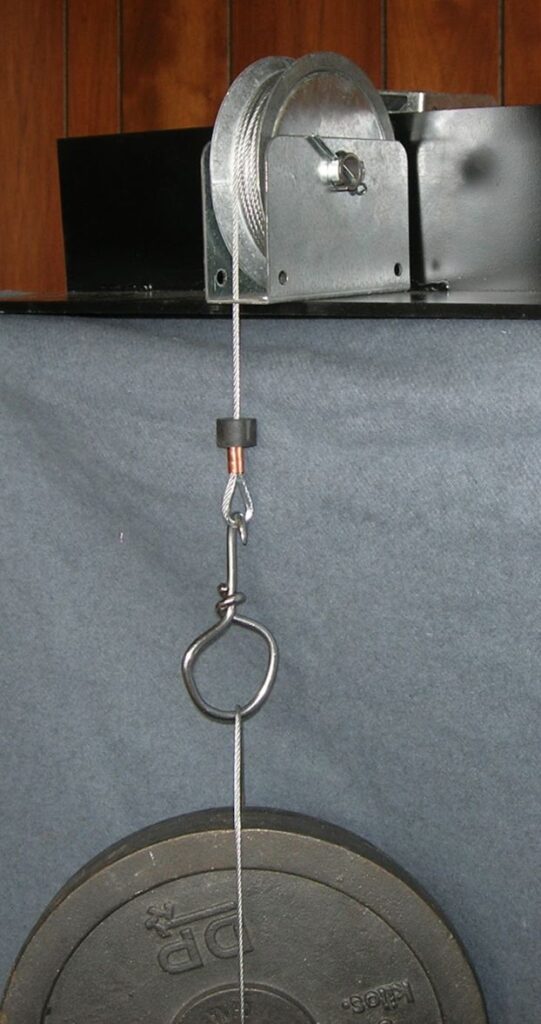
    • Tool balancers utilize load capacity as well as spring tension along a cable to suspend tools in predetermined locations. This is different from a tool retractor that returns the tool to the original position.
    • Load Capacity: The counterbalance needs to be able to effectively offset the weight of the object being balanced.
    • Work Area: Consider the available space and choose a counterbalance that fits comfortably within your workspace.  Dimensions on specification sheet. 
    • Adjustment Options: Some counterbalances offer adjustability, which can be beneficial for situations where the weight being balanced might vary. Video on website shows how to adjust the balance within 1-2 lb increments.
    • The industrial balancer is free floating and supports the proper weight only in the last 30” of the cable length.  A locking mechanism is recommended for safety if holding above 30” functional area.  

    Conclusion:

    Industrial counterbalances offer a simple, low cost, yet powerful solution for maintaining balance and improving efficiency across numerous applications. By understanding the different types, benefits, and considerations for selecting a counterbalance, you can optimize your operations and achieve greater productivity and safety in your industrial environment.